
Begin of page section:
Page sections:

  • Go to contents (Accesskey 1)
  • Go to position marker (Accesskey 2)
  • Go to main navigation (Accesskey 3)
  • Go to sub navigation (Accesskey 4)
  • Go to additional information (Accesskey 5)
  • Go to page settings (user/language) (Accesskey 8)
  • Go to search (Accesskey 9)

End of this page section. Go to overview of page sections

Begin of page section:
Page settings:

English en
Deutsch de
Search
Login

End of this page section. Go to overview of page sections

Begin of page section:
Search:

Search for details about Uni Graz
Close

End of this page section. Go to overview of page sections


Search

Begin of page section:
Main navigation:

Page navigation:

  • University

    University
    • About the University
    • Organisation
    • Faculties
    • Library
    • Working at University of Graz
    • Campus
    Developing solutions for the world of tomorrow - that is our mission. Our students and our researchers take on the great challenges of society and carry the knowledge out.
  • Research Profile

    Research Profile
    • Our Expertise
    • Research Questions
    • Research Portal
    • Promoting Research
    • Research Transfer
    • Ethics in Research
    Scientific excellence and the courage to break new ground. Research at the University of Graz creates the foundations for making the future worth living.
  • Studies

    Studies
    • Prospective Students
    • Students
  • Community

    Community
    • International
    • Location
    • Research and Business
    • Alumni
    The University of Graz is a hub for international research and brings together scientists and business experts. Moreover, it fosters the exchange and cooperation in study and teaching.
  • Spotlight
Topics
  • Our digital Advent calendar
  • Sustainable University
  • Researchers answer
  • Work for us
Close menu

End of this page section. Go to overview of page sections

Begin of page section:
You are here:

University of Graz Faculty of Humanities Department of American Studies News AAAS Conference 7-9 November 2003 (30th International Conference):
  • Our Department
  • People
  • Research
  • Studying
  • News

End of this page section. Go to overview of page sections

Friday, 07 November 2003

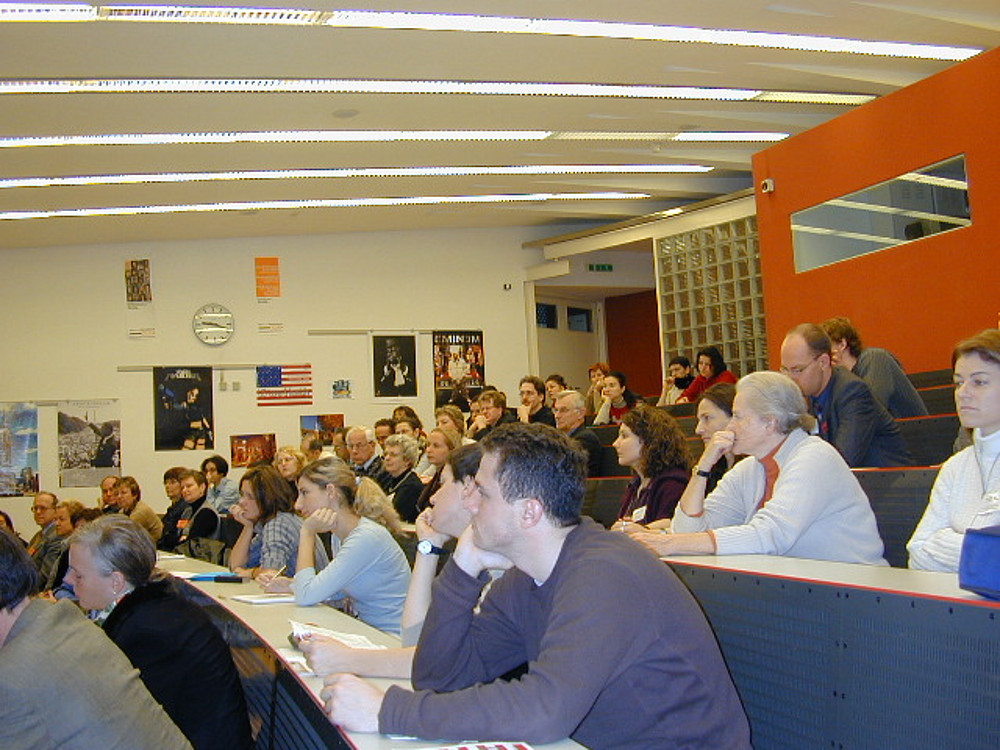
AAAS Conference 7-9 November 2003 (30th International Conference):

U.S. Icons and Iconicity

US cultural icons fall into three main groups: a) fictional as well as historical characters (Daisy Duck to Harvey Milk); b) sites, monuments, natural elements (Ground Zero, Vietnam War Memorial, Buffalos); and c) logos, isotropes, and computer icons (pink triangle, dot-com, Windows, trash bin, etc.).

How do these icons come into being? Who controls their shaping? What aspects of an emotionally, socially and historically complex phenomenon do they cover? What aspects are left out? What denotations and connotations do they carry? What are cultural or political consequences of these icons? What is their relation to the mass media? How do they or their reception change historically? How are they challenged or toppled? Can we do without iconicity? How are these icons appropriated by those on the margins? Icons being symbols of the ruling ideas, what do they tell us about the relations between classes, ethnic groups and genders? And, above all, are they rather manifestations of hegemonic rule (Gramsci, Foucault, Laclau & Mouffe) or manifestations of a shared body of norms and values and therefore democratic elements (Durkheim, Parsons)?

Most social theories today would accept that icons constitute an attempt to focus and anchor the sliding of signification, to freeze the social indetermination into hegemonic forms, and to foster social cohesion by placing consensus over conflict. They are, in short, a central element in the manufacturing of consent. Through their employment, the underlying relationships of historical processes are hidden from our perception; instead, we build our understanding of the world on (mass mediated) appearances.

On the other hand, icons are perhaps best understood as over-determined, as having multiple causations. They are, moreover, like any sign, readable in different ways, carrying endlessly different connotations, betraying in precisely their structure and structural omissions the intangibility of meaning. And, finally, they depend on being accepted by a large number of people and therefore have to win the consent also of the marginalized and the subordinated.

It may be particularly interesting to analyze cultural icons which are contested, ridiculed, appropriated, attacked, supplemented by counter-icons or simply still in the making.

Related news

NOW – AT ONCE – (AS OF) TODAY

American Studies Students’ Successful CCTA 2025 Event in Graz

Rabindranath Tagore Lecture Series

Transnational Dialogues: Bridging Continents Towards a Global Vision

Ausgezeichnet!

Excellence Award 2025

Drag Performers' Online and Offline Identities

DOC Fellowship Programme of the Austrian Academy of Sciences (ÖAW) Lea Pešec

Begin of page section:
Additional information:

University of Graz
Universitaetsplatz 3
8010 Graz
Austria
  • Contact
  • Web Editors
  • Moodle
  • UNIGRAZonline
  • Imprint
  • Data Protection Declaration
  • Accessibility Declaration
Weatherstation
Uni Graz

End of this page section. Go to overview of page sections

End of this page section. Go to overview of page sections

Begin of page section:

End of this page section. Go to overview of page sections