AmLit - American Literatures
The online journal AmLit - American Literatures, located at the Research Area American Studies II at the University of Graz, offers a publication forum for scholarly essays from the fields of American, Canadian, and Latin American literary studies that deal with fictional, non-fictional, and graphic texts, as well as book reviews. The unique philosophy of the journal is its focus on current questions and discourses in literary studies, especially with regard to the research areas ‘Digital Literature & Cultures’, ‘Transnational & Border Studies’ and ‘Visuality & Trans-/Intermediality.’
CALL FOR PROPOSALS FOR AMLIT - AMERICAN LITERATURES
We invite proposals from prospective guest editors interested in curating a special issue for AmLit – American Literatures, a Diamond Open Access journal dedicated to cutting-edge scholarship on contemporary developments in American literatures. AmLit provides a platform for both established and emerging scholars, fostering discussions on how literary texts from North, Central, and South America engage with and narrativize key cultural transformations such as digitization, migration, globalization, trans- and interculturality, as well as visuality and intermediality.
We welcome proposals for special issues typically comprising five high-quality essays. Contributions should engage with fictional, non-fictional, and graphic texts within the fields of U.S. American, Canadian, and Latin American literary studies. The journal’s methodological orientation spans a broad spectrum of literary theories, including (but not limited to) the following approaches:
- Affect Theory & Emotion Studies
- African American, Ethnic & Critical Race Studies
- Critical Digital Humanities & Media Theory
- Critical Disability & Neurodiversity Studies
- Decolonial, Postcolonial & Global South Studies
- Gender, Feminist, Queer & Trans Studies
- Intermediality, Visual Culture & Multimodality
- Marxist, Materialist & Political Economy Approaches
- Narrative Theory, Poetics & Formalisms (incl. postclassical approaches)
- New Historicism & Cultural Materialism
Proposal Guidelines
Please submit a 400–500-word proposal outlining the thematic scope and scholarly significance of your special issue. Please also include:
- Project Status
• Have any contributions already been secured (for example, from a conference, workshop, or research network)?
• Or will you issue a new Call for Papers to recruit contributors?
- Submission Format
Please choose one of the following formats:
• Fully Developed Issue
▪ 400–500-word issue abstract
▪ 250-word abstracts for each planned essay (all combined in a single document)
• New Project
▪ 400–500-word issue abstract
▪ Draft Call for Papers
Potential Topics
We encourage submissions on a wide range of topics, including but not limited to:
- AI, Algorithmic Culture & Machine Creativity (literary authorship, co-creation, and narrative form in the age of large language models)
- Affect, Emotion & Mood Economies (the representation and circulation of feeling in contemporary literary texts)
- American Cultural Production & Political Identity (literary negotiations of nationalism, ideology, public discourse, and the shaping of collective identities)
- Climate Fiction & the Environmental Humanities (Anthropocene narratives, eco-poetics, and environmental justice in literature)
- Critical Digital Humanities & Post-Digital Textuality (e-literature, multimodal storytelling, and the transformation of reading practices)
- Data, Archives & Algorithmic Memory (archival gaps, erasure, and the literary negotiation of digital memory)
- Decolonial & Global South Approaches to American Literatures (hemispheric reconfigurations, epistemic justice, and literary world-making)
- Migration, Borders & Mobility Regimes (literary representations of displacement, diaspora, and transnational belonging)
- Platform Studies & Digital Infrastructures (the impact of digital circulation on literary production, distribution, and reception)
- Queer, Trans & Non-Binary Futures (queer poetics, temporalities, and alternative modes of literary world-building)
- Security, Surveillance & Biopolitics (literary engagements with control, data, and the governance of bodies and populations)
Submission Details
Please send your proposal along with:
- A CV and short bio of the guest editor(s)
- A list of potential contributors (if applicable)
Please submit your proposal as a single PDF (or Word) file containing all elements listed above.
Submissions should be sent to amlit-journal(at)uni-graz.at by Monday, June 1, 2026.
For more information, visit www.amlit.eu.
We look forward to your submissions!
The Editorial Team of AmLit – American Literatures
Current issue:
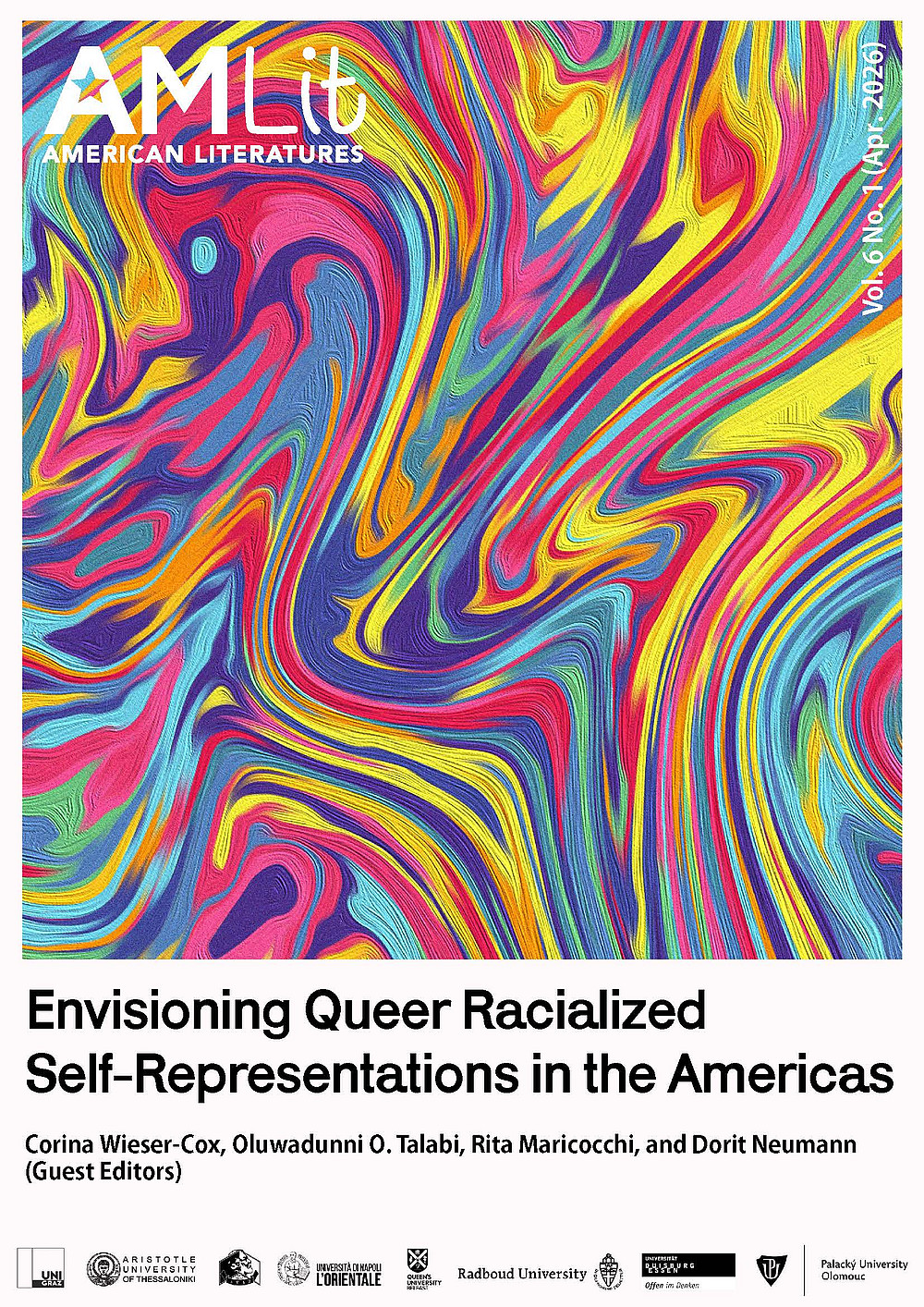
Check out our new special issue of AmLit, titled Envisioning Queer Racialized Self-Representations in the Americas!
This special issue of AmLit explores how queer Black, Indigenous, and other racialized writers and artists represent the embodied reality of queer racialized existence in the Americas. The following questions arise in our engagement with the nexus of queer racialized self-representations in the Americas: How are queer bodies dehumanized through both racialization and heteropatriarchy? Why are modes of self-representation important within the context of queer liberation/personhood in the Americas? What role does literature, an overarching structure of representation, play in the writing of queer and trans bodies in the context of settler-colonialism? How might literature serve as a catalyst for moving beyond a politics of visibility and representation toward modes of engagement grounded in revolution and liberation? This special issue of AmLit seeks to answer these questions. It is the second installment of publications that arose out of the 2023 Postgraduate Conference of the Association for Anglophone and Postcolonial Studies titled, “Queering Postcolonial Worlds.” With an interest in how marginalized writers respond to the ongoing legacies of settler-colonialism in the Americas, this issue centers critical readings of minority literatures that subvert and disrupt dominant subjectivities. The articles cover a wide range of topics that primarily center the self-representations of racialized peoples: in this case, these are Chicanx, Black American, Vietnamese, and Cuban texts that center queer life, desire, love, and intimacy. This shift within the second volume thus highlights the settler colonial aspect of the Americas that continues to haunt and dominate both Indigenous and Black lives within the western hemisphere.