The year 2026 marks the 250th anniversary of the American Declaration of Independence. Last month, Volker Depkat, historian and professor of American Studies at Universität Regensburg, gave two guest lectures at the American Studies Department in Graz. On 19 May, his lecture focused on the American Revolution as a “usable past” (Van Wyck Brooks) in Trump’s America. Prof. Depkat highlighted that the American Revolution was and is still now appropriated by political parties, scholars and artists, and repurposed for their cultural, social and political agendas. Analyzing foundational excerpts from the Declaration of Independence, the Erasmus guest professor problematized their historical meaning, showing that this text prepares the ground for discrimination, individualism and state liberalism. Building on the latter, the Tea Party movement (early 2000s), demanded limited taxation and free markets while criticizing the federal government’s intervention. Another example of debating the legacy of the revolution is the musical Hamilton (2015), which was both praised and criticized for presenting an ethnically varied cast. According to Depkat, the musical builds on the principles of self-determination and natural-rights-consensus while veiling the contributions of African Americans and the role of slavery in the fight for independence. This last theme is instead foregrounded in “The 1619 Project” (2019), since it promotes slavery as the central factor in desiring independence from Britain.
In his second lecture, Prof. Depkat illustrated one of his ongoing projects: a biography of Harriet Tubman, a woman in Maryland who managed to escape slavery and helped set other slaves free through the famous Underground Railroad. She later fought with the Union Army during the Civil War and then settled in New York. Our guest explained that she embraced the role of storyteller for Northern audiences and told her life story, mixing fact with fiction. Her military service during the war was never recognized and she kept living a rather destitute life rather than receiving a pension. The lack of life writing materials – Tubman was illiterate – and the scarcity of available sources make the biographer’s role extremely complicated, explained the speaker. Only a biography written by Sarah Bradford, Scenes in the Life of Harriet Tubman (1869), is available as a written record of Tubman’s life. This brief biography is, however, imbued with the author’s beliefs and style to the extent that its account of Tubman’s life is rather peculiar, with narratorial intrusions and the omission of several episodes of Tubman’s life. As Professor Depkat illustrated, writing a biography with so few and unreliable sources is anything but straightforward.
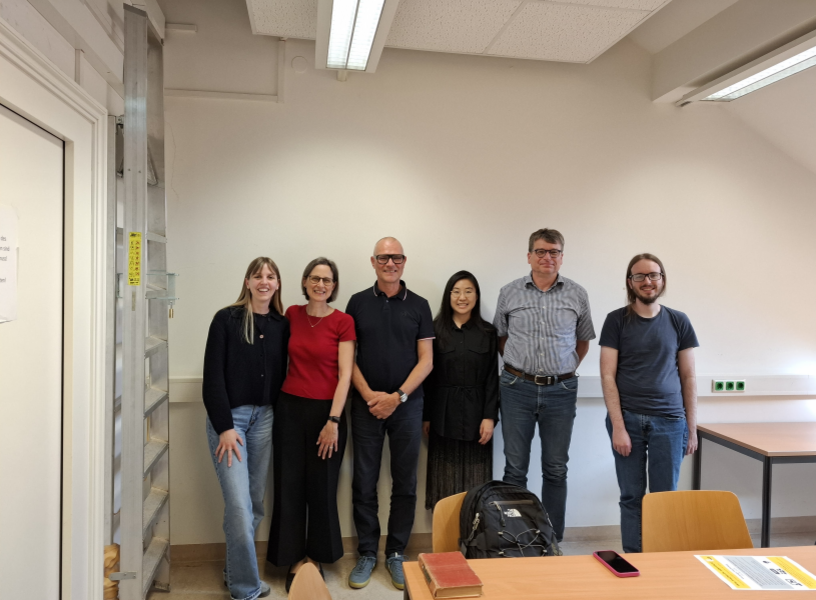
In addition to these lectures, Prof. Depkat also taught a seminar session on several founding documents of the United States and met with PhD students to discuss their current projects. We look forward to seeing his book on Tubman in print and to welcoming him again as an Erasmus professor in the near future. (Anna Lorenzon)